

In the southeastern region of Alberta, the Cypress Hills stand out dramatically against the backdrop of the surrounding prairie.
A closer look reveals another intriguing scenario unfolding below.
Ants are unknowingly clinging to various plants and shrubs within Cypress Hills Provincial Park, awaiting the chance to be inadvertently consumed by a herbivore.
The instigator of this phenomenon is the parasite Dicrocoelium dendriticum, a worm renowned for its remarkable ability to manipulate its host’s behavior.
Researchers from the University of Calgary and the University of Lethbridge note that this parasite deserves a unique spot in the annals of parasitic manipulation, as it can activate and deactivate its control mechanisms—an ability not observed in other parasitic organisms.
Zombies are ubiquitous
Cameron Goater, a parasitologist and professor emeritus at the University of Lethbridge, states that zombie parasites are frequently found in nature.
“Nearly every species on the tree of life is either hosts to or infected by parasites that induce manipulation,” Goater explained.
The ultimate aim often involves transferring from one host to another. Consider the well-known Cordyceps fungus, which gained popularity through a video game series turned HBO hit, The Last of Us. Infected ants ascend plants and perish, allowing the fungus to erupt and shower spores onto unsuspecting ants.
Alternatively, there is the horsehair worm that compels crickets to commit suicide by leaping into water, allowing the worms to emerge and reproduce.
While these instances, like many others across the animal kingdom, typically result in the host’s demise, Dicrocoelium diverges from this pattern, as its life cycle encourages the host’s survival.
Dicrocoelium possesses what parasitologists describe as a complex life cycle that includes multiple hosts, with the final host being a grazing mammal such as elk, deer, or cattle. Adult worms reside in their liver, and their eggs are excreted and subsequently consumed by snails.
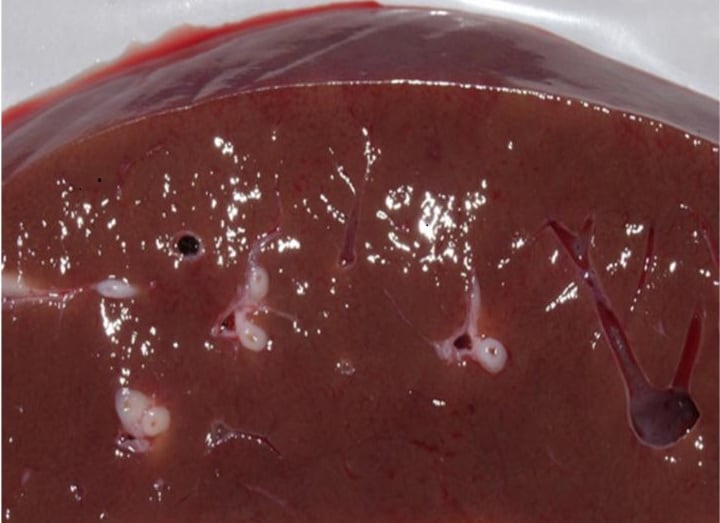
A cross section of an elk liver infected with Dicrocoelium. The white spots are inflamed bile ducts containing an adult worm. (Cameron Goater)
Within the snails, the egg divides into hundreds of larval forms known as cercariae. These are encased in mucus and expelled as a slime ball (this is the official term). Ants then consume these slime balls, though only one cercaria reaches the ant’s abdomen, while a single “brainworm” settles next to the ant’s brain.
This is where the challenges arise.
“The issue is that the final host almost never consumes ants,” Goater noted. “In fact, many animals like deer, elk, and cattle tend to avoid ants.”
Thus, having a brainworm that urges the ants to ascend plants, making them more likely to be accidentally swallowed, is advantageous.
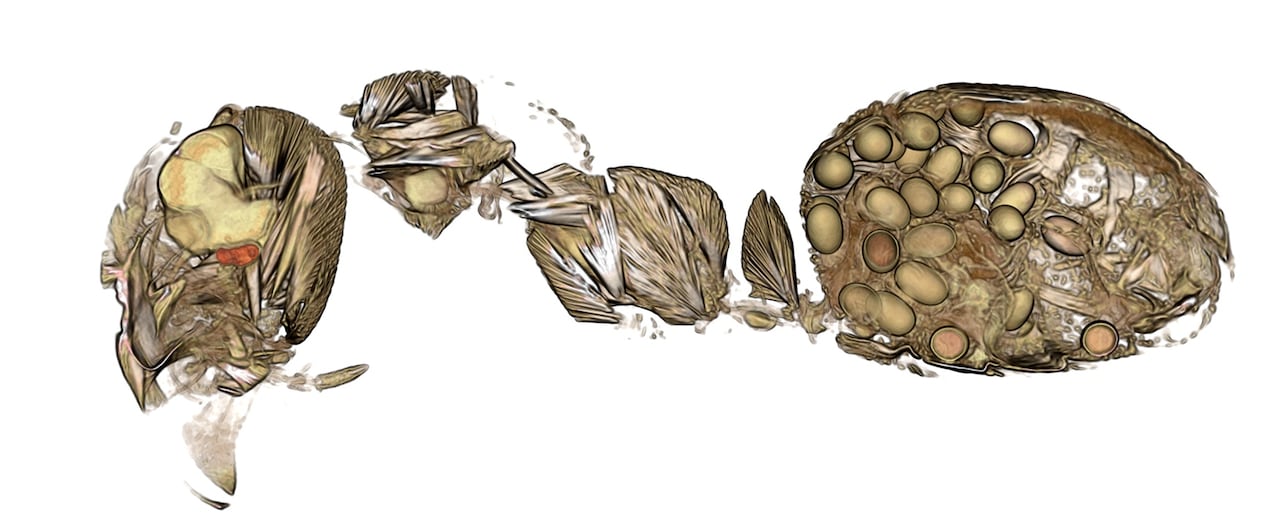
In this CT scan cross section of an infected ant, the small orange area is the brainworm, found below the ant brain. The round grey balls in the abdomen are encysted parasites waiting to be ingested so they can travel to the liver. (Daniel Martín-Vega)
However, this strategy is fraught with risk. Ants that cling to vegetation are vulnerable to predators, are unable to feed, and are, crucially, highly prone to dehydration.
“The way to address this issue is for the ants to detach from the plant and return to their nest,” Goater explained. “This is where the on-off switch comes into play.”
For the remainder of their lives, these ants will scale plants and hold on as long as the temperature remains below approximately 19 degrees Celsius.
How does a parasite residing inside an ant discern external temperature and modify its control accordingly?
“That’s precisely the type of question that keeps us awake at night,” Goater admitted, “because the mechanisms behind that might be entirely novel.”
How to control a mind
The first step in unraveling this mystery involves examining the genes that are active during and after the clinging behavior and comparing them with those of uninfected ants.
“We’ve delved into the ant’s brain to identify the changes from the perspective of the ant,” remarked James Wasmuth, a parasitologist at the University of Calgary. “We observe numerous alterations in various biochemical pathways when the ant exhibits zombie-like behavior.”
While it seems the ant does not perceive its environment in a typical manner under the influence of the parasite, determining a singular alteration that drives this behavior is challenging, according to Wasmuth.
Shelley Adamo, an insect neurobiologist and professor emeritus at Dalhousie University, suggests this is not surprising.
“When I first entered this field, the common belief was that there was a magic bullet,” Adamo recalled.
However, as researchers delve deeper into these systems, they discover that such assumptions are misguided.
“Evolution seldom conducts a complete overhaul,” Adamo explained.
Parasites like Dicrocoelium operate by tapping into existing biological systems, which are already highly intricate.
“We rely on chemicals for communication between nerve cells; it’s not hardwired,” Adamo noted.
This provides the parasite multiple opportunities to interfere, gradually evolving methods to influence these systems to its advantage. The outcome is a series of subtle alterations that culminate in precise behavioral manipulation.
Solving this puzzle necessitates numerous detailed experiments where certain genes are either suppressed or left unaltered to assess if the manipulation persists.
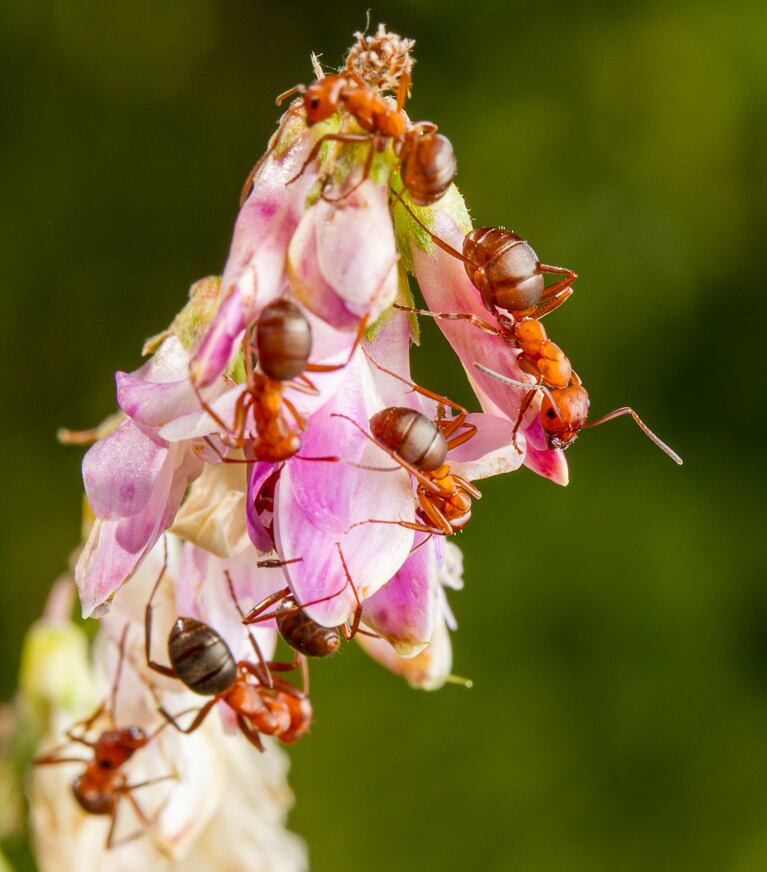
Ants infected with the parasite Dicrocoelium dendriticum cling to plants against their will so they can be eaten by grazing mammals. (Andrew Hurly)
Nonetheless, Adamo is enthusiastic about the initial progress made by the Alberta researchers in identifying potential molecules involved, such as adenosine.
“That molecule is intriguing because it plays a role in both immune and neural systems,” Adamo pointed out.
Wasmuth added that adenosine regulates stress, feeding, and sleep.
“A significant increase in adenosine pathways induces sleep in other animals. Therefore, we suspect that the worm is somehow manipulating the invertebrate’s sleep patterns,” Wasmuth explained, “but we lack definitive evidence.”
In addition to adenosine, certain biochemical pathways associated with olfaction, metabolism, and circadian rhythms appear to be modified, according to Wasmuth.
No magic bullet, but much to explore
Gaining insight into how a parasite alters behavior involves decoding the chemical signals behind that behavior.
“These parasites have uncovered a crucial clue about how brains function, as they can subtly modify elements that lead to significant behavioral changes,” Adamo said.
Humans are similarly vulnerable, Adamo asserts.
“For instance, consuming drugs can alter your brain’s perception of reality.”
This characteristic of animal brains is a double-edged sword: while they possess great plasticity and the ability to learn throughout their lives, “the downside is that they are also susceptible to manipulation if someone understands the chemical signals,” Adamo remarked.
Why Cypress Hills?
Goater believes that Dicrocoelium can provide insights into the ramifications of human interactions with nature.
This parasite likely entered Canada through the importation of sheep and other livestock from Europe decades ago, according to Goater.
So, why is it not found throughout the country?
“This is what we refer to as an anthropogenic introduction of a parasite or disease, as humans brought it here, and our landscape management practices likely influence its transmission as well,” Goater explained.
“Activities in that park significantly enhance transmission, including fire management that results in high densities of both snails and ants,” Goater noted. The park is also designed for cattle grazing, which likely plays a role in this dynamic.
Humans may have unintentionally created ideal conditions for this parasite in Alberta, which Goater finds remarkable given the complexity of its life cycle.
“When it arrived and established itself in these unique environments, it had to transition to a different species of snail, then to a different ant species, and finally to a new grazer species,” he explained.
Gaining understanding of the circumstances that allowed these factors to align, Goater asserts, can guide our responses to various emerging diseases.