

On Friday, two former leaders of Hong Kong’s long-standing vigil commemorating the Tiananmen Square crackdown of 1989 were found guilty in a national security case initiated under a law imposed by China, which has significantly stifled the city’s once-vibrant pro-democracy movement.
Lee Cheuk-yan and Chow Hang-tung, who previously headed the Hong Kong Alliance in Support of Patriotic Democratic Movements of China, were charged in 2021 with inciting subversion as per the national security law. Both defendants maintained their innocence and now face a potential maximum sentence of 10 years. The alliance itself was also convicted.
The ruling by the three judges indicated that the alliance’s demand to “end one-party dictatorship” was interpreted as an intention to dismantle the ruling Communist Party’s status under the constitution, rather than a call for a multiparty system. The phrase “end” was understood to imply “overthrowing” and “undermining.”
The judges stated in their ruling that the defendants continued to propagate this call after the law was enacted, disregarding the fact that such actions contravened the constitution, which designates the party’s leadership as a fundamental aspect of socialism with Chinese characteristics. This constitutes “other unlawful means” as defined by the security law, the judges concluded.
This verdict is part of the ongoing crackdown on Hong Kong’s pro-democracy movement, which has been largely dismantled by authorities in Hong Kong and mainland China.
For thirty years, the candlelight vigil organized by the alliance was the only significant public event honoring the victims in China, consistently drawing tens of thousands of attendees each year. However, the event was prohibited in 2020 during the initial phase of the COVID-19 pandemic, just weeks before Beijing enacted the security law to suppress the widespread anti-government protests in 2019.
Diminishing freedom of expression
As they exited the courtroom, Lee and Chow smiled and waved at their supporters. Sentencing will take place at a later date, and they are expected to request lighter sentences next week, according to one of the judges.
Many observers believe the trial reflects the diminishing freedom of expression in the former British territory, which reverted to Chinese sovereignty in 1997.
The judges have yet to disclose the rationale for the conviction, stating that the complete judgment will be accessible online later.
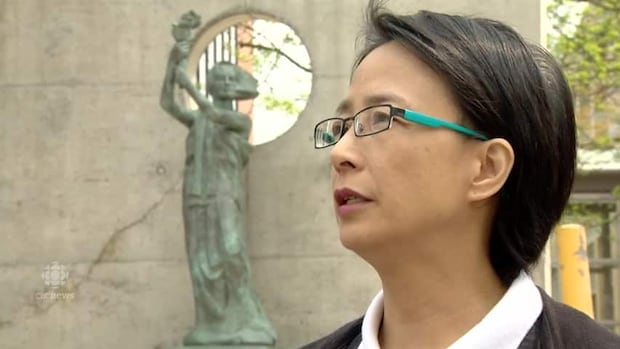
Thirty years later, Liane Lee is still telling the world about what she experienced in Tiananmen Square as a student protester because she feels it’s her duty.
Eric Lai, a senior fellow with the Georgetown Center for Asian Law, remarked that the charge of inciting subversion is frequently utilized in mainland China to target human rights lawyers, activists, and intellectuals, including the late Nobel laureate Liu Xiaobo.
“This case illustrates the extent to which the court in Hong Kong has aligned itself with the party-controlled judiciary of the mainland,” he stated.
The pair faced accusations of encouraging the overthrow of the ruling Communist Party of China.
During the proceedings, prosecutors asserted that the case was non-political and centered on the alliance’s alleged incitement of others to topple the Communist Party’s leadership through illegal means, highlighting the demand to “end one-party rule,” which is fundamental to the group’s mission.
However, Lee defended in court that the demand was not aimed at abolishing the party’s leadership but rather at advancing democracy, allowing the populace to choose their leaders, and asserting that the Communist Party should not enforce “dictatorship.”
Chow, acting as her own lawyer, contended that “ending one-party rule” signifies the termination of an unrestrained power structure. She criticized the inversion of moral standards applied in this case.
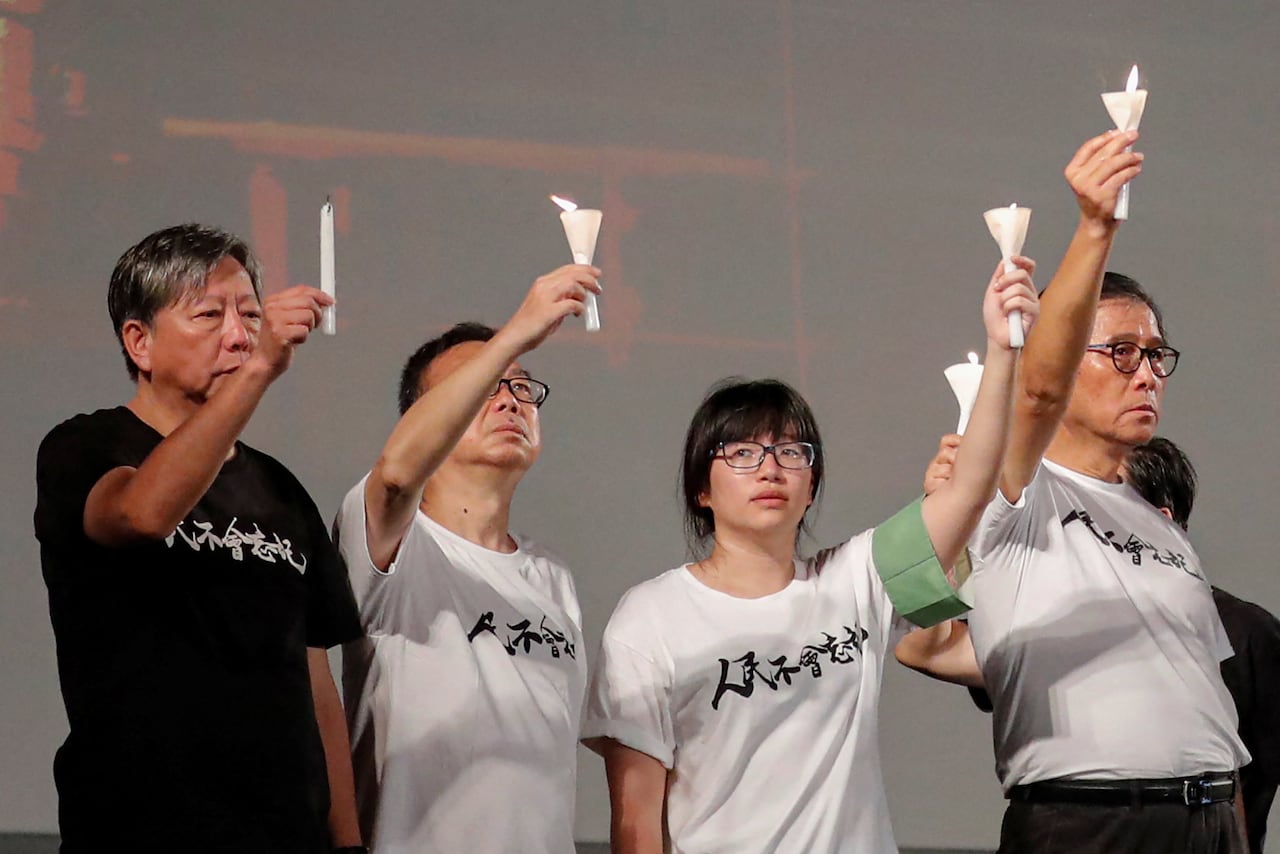
Pro-democracy activists Lee Cheuk-yan, left, Cheung Man-kwong, and Chow Hang-tung pay tribute to those who died during a candlelight vigil marking the 30th anniversary of the Tiananmen Square crackdown in Hong Kong in June 2019. Lee and Chow were convicted Friday of inciting subversion. (Tyrone Siu/Reuters)
In a Patreon post on Thursday, she recounted her experiences of being restrained with handcuffs and chains during court transfers from prison, stating she was escorted by correctional officers “like a dog.”
“Justice resides in the hearts of the people. There is no need to adhere to this kind of top-down ruling; one verdict holds little significance,” she expressed.
The trial, originally set to last 75 days, concluded unexpectedly early, finishing its closing arguments on the 24th day. At the trial’s onset in January, Albert Ho, another defendant, entered a guilty plea, which could typically lead to a lighter sentence.
Lee and Chow are anticipated to appeal for reduced sentences during a separate hearing, potentially being sentenced alongside Ho.
Following the verdict, Lee’s spouse, Elizabeth Tang, expressed her disappointment and anger to reporters, acknowledging that while she had expected the outcome, she believed Lee was innocent.
“I find this unjust. It seems the judges disregarded our lawyers’ arguments and evidence,” she remarked, adding that they would consider whether to appeal at a later time.
Supporters question the allegations
Dozens gathered outside the courthouse under light rain prior to the hearing.
Tang Ngok-kwan, a former member of the alliance, mentioned that police prevented him from joining the line if he insisted on carrying “sensitive” items, including bookmarks with the phrase “vindicate June 4,” the anniversary of the crackdown. He chose not to enter the courtroom.
Tang stated that a guilty verdict for the alliance would “upend his understanding” of the city’s legal framework.
In the violent crackdown of 1989, hundreds, possibly thousands, lost their lives as military tanks advanced into central Beijing. This event was a crucial moment in modern Chinese history, affirming that the market reforms that propelled the nation to become the world’s second-largest economy would not coincide with political liberalization.
After the lifting of COVID-19 restrictions, the former vigil location in Hong Kong was instead transformed into a carnival organized by pro-Beijing groups.
Beijing has asserted that the security law enacted in 2020 was essential for maintaining stability in the city. Many leading activists have been imprisoned under this law, including former media tycoon Jimmy Lai. Amid drastic political shifts, numerous civil society organizations have dissolved, including the alliance.