

Governor Tiff Macklem of the Bank of Canada has indicated that the risk of inflation is increasing, with rising energy prices emerging as a significant factor alongside Canada’s new dollar-for-dollar tariffs on U.S. products, which could drive up costs for consumers and businesses.
Macklem’s comments on Wednesday followed the central bank’s decision to maintain its key interest rate at 2.25 percent, a move that economists had largely anticipated. This rate was reduced to its current level in October of the previous year, and this announcement marks the seventh consecutive occasion the bank has decided against altering its key policy rate.
“The counter-tariffs, as well as the U.S. tariffs, will impose additional costs on certain businesses,” Macklem informed journalists in Ottawa. “These tariffs are quite high, but they affect a relatively small number of goods.”
He emphasized that the more pressing concern is the ongoing conflict in the Middle East.
“The situation has escalated again. Oil prices have risen,” Macklem stated. “The longer this conflict continues, the greater the risk that it may influence the prices of a wider range of goods and services.”
In its statement, the bank acknowledged that recent economic data supports its expectation of a “broadening recovery.” However, it also noted that the war and tariffs from the U.S. increase the risk of inflation rising further.
Since the bank’s last update in July, U.S. oil prices have surged approximately 13 percent. The conflict led by the U.S. in Iran has intensified recently, causing a slowdown in tanker traffic through the Strait of Hormuz, which is a vital route for oil shipments to global markets.
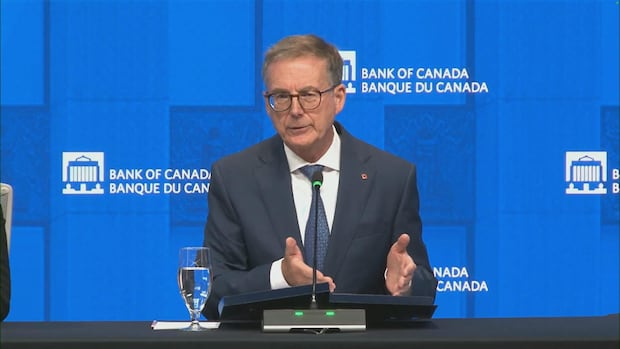
According to Bank of Canada governor Tiff Macklem, while there will be updates to estimates, officials currently believe the ‘inflationary impact of those counter-tariffs is fairly modest,’ highlighting that the situation in the Middle East remains a ‘greater concern’ for inflation.
Simultaneously, the trade conflict between Canada and the U.S. has escalated significantly since the bank’s last meeting in July.
Last month, U.S. President Donald Trump enacted tariffs of 50 percent on approximately $28 billion worth of Canadian goods. Starting Tuesday, Canada will respond with equivalent tariffs on $27.6 billion of similar U.S. products.
Recently, the federal government introduced a $7.5-billion expanded economic assistance program aimed at supporting affected workers and businesses. This new support is in addition to nearly $25 billion in tariff relief provided over the last 18 months.
Macklem: Inflation is ‘too high’
In July, Canada’s inflation rate increased to three percent, influenced by the conflict in the Middle East, which has affected gas prices in Canada.
“That’s excessive,” Macklem remarked, reiterating the bank’s goal of maintaining inflation at two percent. “The increase is heavily concentrated in gasoline and oil prices, which are directly influenced by the situation in Iran.”
Derek Holt, the vice president and head of capital markets economics at Scotiabank, noted that Macklem has placed significant emphasis on the upcoming economic forecasts expected in October.
“There’s a lot of data to analyze before October 28, including information on inflation, employment, and GDP, as well as developments in energy markets and trade. The Bank of Canada has clearly opened the possibility of tightening rates as early as the next meeting, provided conditions are favorable,” Holt commented in a research note.
He anticipates a 75 basis point increase in rates starting in the fourth quarter of 2026.
Trade uncertainties
CIBC’s chief economist Avery Shenfeld mentioned that Wednesday’s decision to hold the rate was expected “amidst the uncertainties of a trade war.”
“The increased uncertainty surrounding trade relations complicates any predictions about the future,” Shenfeld stated in a research note released after the announcement.
“The bank assessed that the immediate effects of the recent tariffs would not be significant, but acknowledged that trade uncertainties continue to weigh down the outlook,” he added.
“It did not address the negative consequences of a failure to reduce current tariffs on automobiles, metals, and lumber, which many economic forecasts had assumed would occur.”
Shenfeld expressed skepticism about the likelihood of any rate changes in 2026, highlighting that both the oil situation and trade conflicts could change markedly in the coming months.
Bond market developments
While the Bank of Canada directly influences short-term borrowing rates, long-term rates are determined by the bond market. In the U.S., treasury yields have surged to multi-year peaks as investors seek higher returns, partly due to expectations that the U.S. Federal Reserve will raise its short-term benchmark rate.
“We’re observing some influence of global bond yields on Canada,” Macklem remarked on Wednesday, noting that Canadian yields remain significantly lower than those on U.S. treasuries.
“It’s crucial to differentiate between volatility and dysfunction when yields are fluctuating, as this reflects investors reassessing risk,” Carolyn Rogers, Senior Deputy Governor of the Bank of Canada, explained to reporters.
“The vulnerabilities we’ve discussed in previous financial stability reports arise when leveraged investors rapidly unwind their positions, leading to a liquidity squeeze,” she added. “We currently do not see those conditions emerging.”
The 10-year Government of Canada bond yield rose above basis points to 3.80 percent on Wednesday, reaching its highest level in over two years.
A Reuters survey conducted on August 22 revealed that all 35 economists surveyed anticipated that the central bank would maintain the key rate during Wednesday’s meeting. The next rate announcement from the Bank of Canada is set for October 28.