

As Canadian negotiators return home and U.S. tariffs have reached 50 percent, the Canadian business sector is assessing the potential impact of these new taxes.
Leaders from various industries, ranging from plywood to wine exporters, are expressing concerns that these elevated tariffs will effectively halt their trade with the United States.
But what does this mean for the overall economy? Which industries will be most affected, and what are the implications for employment in Canada? Here’s a summary of the key points.
BMO predicts a potential half-point drop in GDP
The newly imposed 50 percent tariffs apply to a variety of products, totaling approximately $28 billion in Canadian exports to the U.S.
Although this figure represents only about five percent of Canada’s overall exports to the U.S., BMO senior economist Robert Kavcic has noted that this is relatively limited.
BMO projects that these tariffs could reduce Canada’s GDP growth by half a percentage point, partly because the new tariff landscape will deter businesses from making investments that could spur economic growth.
Kavcic remarked that these tariffs have come at a particularly unfortunate moment, as Canada’s economy was starting to show signs of recovery. After a sluggish start to the year, growth has picked up in recent months, setting the stage for a robust rebound in the second quarter.
‘Your U.S. market could effectively disappear’
While the overall economic impact may appear moderate at the national level, specific industries concentrated with tariffs will experience significant challenges.
“$28 billion may seem manageable,” Kavcic noted, but he cautioned, “For small and medium-sized enterprises in sectors facing these 50 percent tariffs, the U.S. market could virtually vanish.”
According to CBC’s analysis of export data from the United States International Trade Commission, the electronics and electrical equipment sector will experience the most severe effects from the tariffs. In 2025, Canada exported over $4 billion worth of electronic equipment that is now subject to these tariffs.
Following electronics, plastics rank second on the list, with $3 billion of these products exported to the U.S. last year, while furniture, bedding, and lighting follow closely with $2.5 billion. The fourth and fifth spots are held by industrial machinery and paper products, respectively.
The majority of manufacturing for these electronic goods, plastics, and furniture occurs in Ontario and Quebec, making these provinces particularly vulnerable to the new tariffs.
Moreover, British Columbia is significantly affected due to its considerable exposure to tariffs on paper and wood products, with newly taxed items accounting for over 13 percent of the province’s total exports to the U.S.—the highest rate among all provinces.
Smaller businesses face disproportionate effects
In addition to major manufacturing sectors, the newly taxed items encompass a diverse array of consumer goods, such as honey, candles, and hockey sticks.
“It’s a rather unusual assortment of products that haven’t previously been subject to various other tariffs,” Kavcic observed.
These types of goods are typically exported by smaller Canadian companies, which may find it easy to replace these products with American alternatives.
This scenario could disproportionately impact smaller businesses, which often lack sufficient financial reserves to navigate these challenging circumstances. The Canadian Federation of Independent Business (CFIB) reported that 40 percent of its members who export to the U.S. produce items affected by the tariffs.
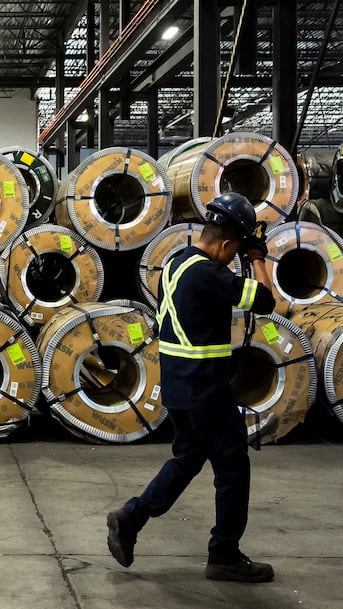
After Canada-U.S. trade discussions collapsed, U.S. President Donald Trump imposed 50 percent tariffs on various products. Analysis from economist Trevor Tombe indicates that if these tariffs persist, Canada could lose tens of thousands of jobs.
Among small and medium-sized business owners, 35 percent indicated they expect their revenue to decline by at least 50 percent due to the tariffs, while 78 percent stated that the new tariffs would render their products uncompetitive in the U.S. market.
Dan Kelly, the president of CFIB, shared with CBC News over the weekend that some of the businesses he represents might be effectively “finished” due to the new tariffs.
Economist predicts 87,000 job losses
A recent analysis by University of Calgary economics professor Trevor Tombe suggests that tens of thousands of jobs in Canada could be at risk due to the new tariffs.
Tombe indicated that around 52,000 jobs in directly affected sectors are at risk, but industries that support these tariff-affected sectors also face potential job losses. Industries such as trucking and bookkeeping services may also suffer, leading to an additional estimated loss of 35,000 jobs due to this ripple effect.
“All of these sectors, essentially throughout the Canadian economy, are indirectly affected. Consequently, job losses in those sectors will accumulate over time,” Tombe stated during an interview with CBC News.
In total, Tombe estimates that the job losses could reach approximately 87,000.
These job losses would not be limited to Ontario, Quebec, and B.C.
For instance, Alberta exports a smaller quantity of products affected by the new tariffs, yet it could still face around 9,000 job losses due to its industries that support exporters, according to Tombe’s findings.
Uncertainty — an immeasurable risk
Although the immediate effects of the tariffs will primarily impact specific provinces and sectors, they introduce a significant nationwide risk: uncertainty.
“It’s the uncertainty that’s likely to hinder economic growth much more than the tariffs themselves,” Tombe observed.
This uncertainty has been a concern since U.S. President Donald Trump’s trade war with Canada commenced approximately 18 months ago, but the breakdown of talks has exacerbated the situation.
Prime Minister Mark Carney has promised retaliatory tariffs on a “dollar-for-dollar” basis, but which American goods will be included in that response remains unclear. Furthermore, Trump’s threats of raising tariffs to 50 percent on Canadian automobiles and steel only heighten the uncertainty surrounding additional products potentially entering the retaliatory cycle.

Prime Minister Mark Carney stated on Monday that U.S. President Donald Trump is following a pattern that the government anticipated by targeting the automotive sector. ‘What message does that convey to workers in Michigan, Ohio, Kentucky, and Alabama who depend on Canadian demand?’ Carney questioned.
“The larger concern is that Canada retaliates, prompting the U.S. to respond in turn,” Kavcic from BMO warned. “Given that the U.S. economy is ten times larger than Canada’s, can we realistically win such a tit-for-tat conflict? Probably not.”
These negotiations were also anticipated to set the stage for more extensive discussions regarding the Canada-U.S.-Mexico Agreement (CUSMA); thus, this breakdown has cast doubt on the future of the trade agreement.
An analysis by Oxford Economics prepared for the Canadian American Business Council earlier this month projected that more than 100,000 Canadian jobs could vanish if CUSMA were to collapse, costing the Canadian economy $271 billion by 2035.
The prevailing hostility is likely to linger, as Kavcic noted, considering that the Trump administration still has two years left in office and the president’s inclination towards tariffs shows no signs of diminishing.
“The prevailing sentiment now seems to be that this relationship is irreparably damaged for the foreseeable future,” Kavcic remarked.
“So, if you’re a business owner, should you delay hiring? Perhaps. Should you postpone business investments? Likely, until the situation clarifies.”